Passive Income
Best Digital Products to Sell Online for Passive Income
Last reviewed: September 1, 2026
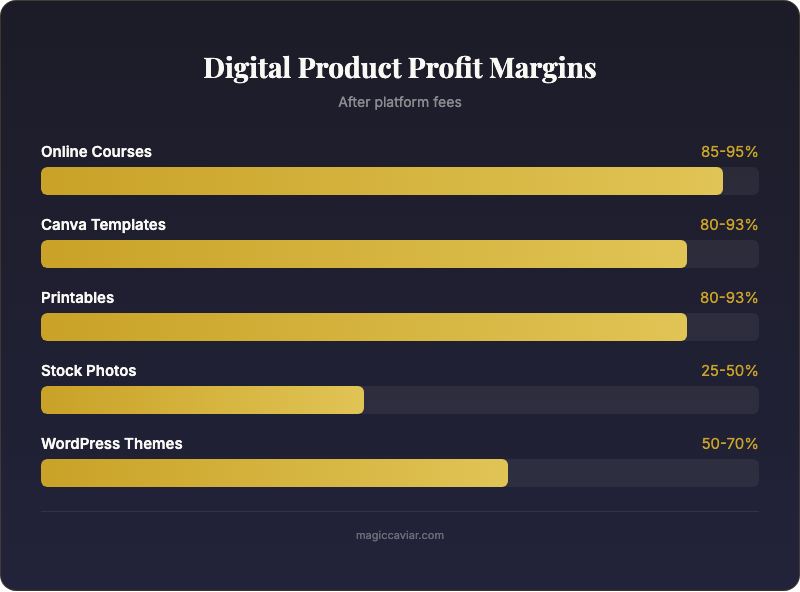
Digital products are the closest thing to true passive income online. You create them once and sell them indefinitely with no inventory, no shipping, and profit margins above 80%. Online courses, templates, ebooks, and software tools are the four highest-earning categories. This guide ranks eight digital product types by their real passive income potential, using platform data and seller reports rather than aspirational projections.
Online courses generate the highest passive income ceiling at $500 to $50,000 per month for established creators. Canva and Notion templates offer the fastest path to first sales with the lowest creation time. Ebooks earn modestly but compound over years. Software tools and plugins have the highest margins but require technical skills to build.
Every product type below was evaluated against real seller data from Teachable, Etsy, Gumroad, and Amazon KDP. For the full beginner overview, see our guide to building passive income online. Our verification process is detailed on the How We Research page.
Online courses lead in total revenue potential because they command premium prices ($50 to $500 per sale) and can be marketed through evergreen funnels. Templates rank second for beginners because they sell at lower prices ($3 to $15) but require minimal creation time and sell in high volume on marketplaces like Etsy and Gumroad.
| Product Type | Creation Time | Price Range | Monthly Income Potential | Recurring Revenue | Best Platform |
|---|---|---|---|---|---|
| Online Courses | 40-100 hours | $50 – $500 | $500 – $50,000 | Yes (membership models) | Teachable, Udemy |
| Templates (Canva/Notion) | 2-10 hours per set | $3 – $20 | $100 – $3,000 | No (one-time sales) | Etsy, Gumroad |
| Ebooks | 40-80 hours | $3 – $15 | $50 – $2,000 | No | Amazon KDP |
| Printables | 1-5 hours per design | $2 – $10 | $50 – $1,500 | No | Etsy |
| Stock Photos/Videos | Ongoing shooting | $0.25 – $5 per download | $50 – $1,000 | Yes (portfolio grows) | Shutterstock, Adobe Stock |
| Software/Plugins | 100-500 hours | $10 – $100/month | $500 – $20,000 | Yes (subscriptions) | Own site, AppSumo |
| Music/Audio | 5-20 hours per track | $1 – $50 per license | $50 – $2,000 | Yes (licensing) | AudioJungle, Epidemic Sound |
| Fonts/Graphics | 20-60 hours per set | $10 – $50 | $100 – $3,000 | No | Creative Market, MyFonts |
Courses command premium pricing because they promise transformation, not just information. A $200 course on freelance copywriting promises a career change. A $5 ebook on the same topic promises knowledge. According to Teachable’s creator data, the average course price on their platform is $182, and top creators earn over $1 million annually from course sales alone.
The creation investment is significant. A quality course requires video recording, editing, slide design, and curriculum planning. Budget 40 to 100 hours for a comprehensive course. Equipment costs range from $0 (screen recordings with free tools) to $500 (basic camera, microphone, and lighting).
Two models exist: marketplace and self-hosted. Udemy provides a built-in audience but controls pricing and takes up to 63% of revenue from organic sales. Teachable and Thinkific let you set your own price and keep 90% or more, but you must drive your own traffic.
My strong opinion: if you have expertise that can be taught, courses are the single best digital product to build. The upfront work is heavy, but the per-sale revenue dwarfs every other category. Start with a mini-course (2 to 3 hours of content, priced at $47 to $97) to validate demand before building a flagship program. For the complete walkthrough, read our guide on creating and selling online courses as a beginner.
Templates are the fastest digital product to create and sell. A set of 20 Instagram post templates takes 3 to 5 hours in Canva. A Notion dashboard template takes 2 to 4 hours. Etsy charges $0.20 per listing with no monthly fee. You can have your first product listed and potentially earning within a single weekend of focused work.
The template market on Etsy has exploded. According to Etsy’s Seller Handbook, digital downloads are one of the fastest-growing categories on the platform. Social media templates, resume templates, wedding invitations, and digital planners dominate the top seller lists.
The downside is low per-sale revenue. A template bundle selling at $8 nets roughly $7 after Etsy fees. You need volume to build meaningful income. Sellers with 50 to 100 listings and strong reviews report $500 to $2,000 per month. Sellers with fewer than 20 listings typically earn under $200.
Templates work best as a starting point, not an endpoint. Build a template shop to learn digital product creation, audience building, and marketplace optimization. Then use that foundation to create higher-priced products like courses or software. For the printables-specific angle, see our guide on selling printables on Etsy with no design experience.
Ebooks generate modest but consistent income over long periods. Amazon KDP pays 35% to 70% royalties depending on pricing and distribution options. A well-positioned nonfiction ebook priced at $4.99 earns roughly $3.40 per sale at the 70% royalty rate. Selling 10 copies per day produces about $1,020 per month. Most self-published authors sell far fewer copies than that.
The ebook market favors nonfiction how-to content over fiction for passive income purposes. A book titled “Beginner’s Guide to Bookkeeping from Home” has stable search demand year-round. A novel competes with millions of titles for attention.
Amazon KDP is free to publish on. You upload a manuscript and cover, set your price, and Amazon handles printing (for paperback) and digital delivery. The platform’s search algorithm surfaces books based on keywords, categories, and sales velocity.
Ebooks work best as part of a broader strategy. A $5 ebook can serve as the entry point to a $200 course. Readers who find value in your book become warm leads for higher-priced offerings. The book itself may earn modestly, but its role as a marketing tool multiplies its value.
Software products have the highest passive income ceiling because they generate recurring subscription revenue. A WordPress plugin or SaaS tool charging $10 per month with 500 subscribers produces $5,000 monthly. The barrier is technical skill: you need programming ability or the budget to hire a developer. AppSumo lifetime deals can jumpstart early revenue, though they sacrifice long-term recurring income.
Building software is the most demanding path on this list. Development takes 100 to 500 hours for a minimum viable product. Ongoing maintenance, bug fixes, and customer support add recurring work that other digital products avoid.
The tradeoff is worth it for technical creators. A template shop might earn $2,000 per month after years of work. A single successful SaaS tool can reach $10,000 per month within 12 to 18 months. The compounding effect of subscription revenue is the most powerful income model in the digital product space.
For non-technical creators, consider no-code tools. Platforms like Bubble and Softr let you build web applications without writing code. The results are less flexible than custom development but sufficient for simple tools, directories, and membership sites.
Start with the product type that matches your strongest existing skill. Writers should start with ebooks or content templates. Designers should start with Canva or graphic templates. Teachers should start with mini-courses. The best first product is the one you can complete and list for sale within two weeks, because launching teaches more than planning.
The common mistake is spending months building a “perfect” product before testing the market. Create a minimum viable product, list it, and let buyer feedback guide improvements. A template set that sells 5 copies in its first month confirms demand. No sales in 30 days means you need to adjust the product, the pricing, or the marketing.
For the complete passive income framework, visit our step-by-step passive income guide. The strategy applies whether you choose templates, courses, or any other digital product type.
Links verified at the time of writing.
Canva templates and printables have the lowest startup cost at $0 to $13 per month (Canva Pro optional). Etsy listings cost $0.20 each. You can launch a template shop with 10 products for $2.00 total investment. Ebooks on Amazon KDP are also free to publish.
Templates on Etsy typically take 3 to 6 months of consistent listing (50 or more products) to reach $1,000 monthly. Online courses can reach that level with a single successful launch if you have an existing audience. Ebooks rarely reach $1,000 per month from a single title without significant marketing effort.
Yes, unless a platform requires exclusivity. Amazon KDP offers higher royalties (70% vs 35%) for ebooks enrolled in KDP Select, which requires Amazon exclusivity. Etsy, Gumroad, and most other platforms have no exclusivity requirements. Listing on multiple platforms increases your total reach.
Requirements vary by state and country. In the United States, most states do not require a business license for online digital product sales under a certain revenue threshold. However, you must report all income for tax purposes. Consult a local accountant once your digital product income exceeds $1,000 per year.