Getting Started
How Long Does It Actually Take to Make Money Online
Last reviewed: September 1, 2026
The honest answer is that most online income methods take longer than advertised and shorter than pessimists claim. Freelance services pay within one to three weeks of landing your first client. Digital products take two to four months to generate consistent sales. Blogging and affiliate marketing take six to twelve months before meaningful income appears. This guide gives you real timelines for ten methods.
Service-based work like freelancing and virtual assistant tasks produces income fastest, typically within two to four weeks. Product-based methods like Etsy shops take two to four months. Content-based methods like blogging and YouTube take six to eighteen months. No legitimate method produces full-time income in 30 days from a standing start.
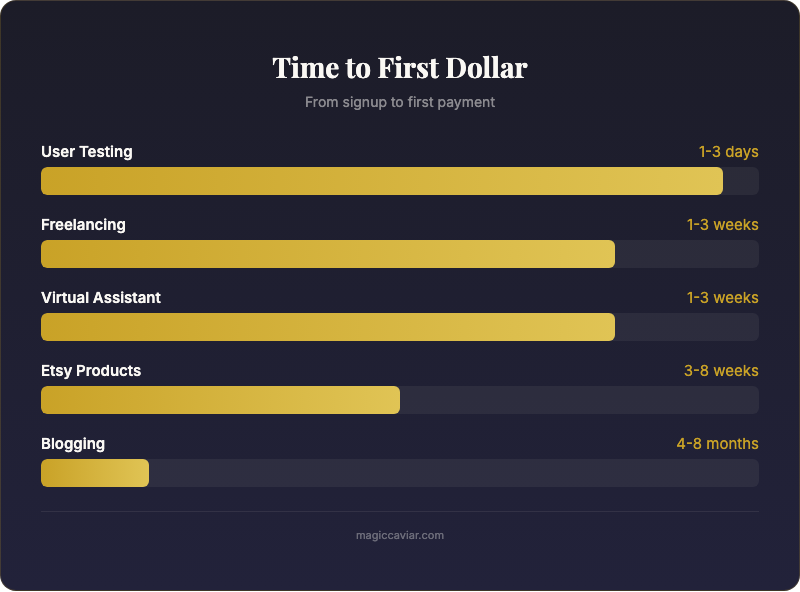
Every “make money online” guru claims you can replace your salary in 30 days. That is a sales pitch, not a timeline. The table below is based on reported experiences across platforms like Upwork, Etsy, and YouTube, verified against their official documentation and our research methodology. For a starting overview, see our beginner’s guide to making money online.
User testing pays fastest at one to three days after account approval. Freelance platforms like Upwork typically produce the first payment within one to three weeks. Etsy digital products take three to eight weeks. Blogging income usually appears after four to eight months. The first dollar is the hardest. After that, scaling follows a more predictable curve.
| Method | Time to First Dollar | Time to $500/Month | Time to $2,000/Month | Effort Required |
|---|---|---|---|---|
| User Testing | 1 to 3 days | Unlikely (limited volume) | Not realistic | Low |
| Freelance Writing | 1 to 3 weeks | 1 to 2 months | 3 to 6 months | Medium |
| Virtual Assistant | 1 to 3 weeks | 1 to 3 months | 4 to 8 months | Medium |
| Online Tutoring | 1 to 2 weeks | 2 to 4 months | 4 to 8 months | Medium |
| Web Development | 2 to 4 weeks | 1 to 3 months | 3 to 6 months | High |
| Etsy Digital Products | 3 to 8 weeks | 3 to 6 months | 6 to 12 months | Medium |
| YouTube | 3 to 12 months | 6 to 18 months | 12 to 24 months | High |
| Blogging | 4 to 8 months | 8 to 14 months | 14 to 24 months | High |
| Affiliate Marketing | 2 to 6 months | 6 to 12 months | 12 to 24 months | High |
| Online Courses | 1 to 3 months | 3 to 8 months | 6 to 14 months | High |
These ranges assume 10 to 15 hours per week of focused work. Working more hours compresses the timeline. Working fewer hours extends it. The “effort required” column reflects both time commitment and skill complexity.
Service work pays faster because you exchange time for money directly. A freelance writer completes an article, the client pays. There is no audience to build, no product to create, and no algorithm to satisfy. The tradeoff is that service income stops when you stop working. Product and content income compounds over time but requires months of unpaid effort upfront.
According to Upwork, freelancers who complete their profile and submit 15 or more proposals in their first week have significantly higher success rates than those who apply to fewer than five jobs. The platform rewards active effort with better visibility in search results.
The same principle applies to Fiverr. New sellers who create five or more gig listings and respond to buyer inquiries within one hour see their first order within days rather than weeks. Platform algorithms favor responsiveness.
For a practical system to accelerate your timeline, read our guide on making your first $1,000 online.
True passive income from blogging, YouTube, or digital products requires six to eighteen months of consistent work before generating meaningful revenue. The term “passive” is misleading. The income is recurring, not effortless. You build the asset (a blog, a channel, a product catalog) through active work, and then it earns while you sleep. But building the asset takes months.
According to research from Ahrefs, only 5.7% of newly published pages reach Google’s top 10 within one year. For bloggers, this means most articles you write today will not generate significant search traffic for six to twelve months.
YouTube follows a similar curve. According to YouTube’s monetization requirements, you need 1,000 subscribers and 4,000 watch hours in the previous 12 months to join the Partner Program. Most creators take six to twelve months to reach this threshold.
Etsy digital products fall in between. According to Etsy’s Seller Handbook, new shops receive a temporary boost in search visibility. Shops that capitalize on this window with 20 or more optimized listings in the first month reach profitability faster.
Three factors accelerate the timeline: existing skills that transfer directly, consistent weekly output of 15 hours or more, and focusing on one method without switching. Three factors slow it down: choosing a method that does not match your skills, spending more time consuming courses than doing the work, and trying to build multiple income streams simultaneously.
The biggest accelerator is skill alignment. A professional writer who starts freelancing will land clients in days, not weeks. A retail worker with strong customer service skills will thrive as a virtual assistant. A designer who opens an Etsy shop has a head start on product quality.
The biggest drag is course consumption. People who spend three months watching YouTube videos about freelancing before sending a single proposal have wasted three months. The learning happens in the doing, not in the watching. Free platform documentation covers everything you need to start.
For help identifying which method matches your skills, see our guide on becoming a virtual assistant with no experience.
Month one earns $0 to $200 for most people. Months two through four reach $200 to $800 as skills improve and client relationships develop. Months five through eight bring $500 to $1,500 as you raise rates or build product inventory. Months nine through twelve can reach $1,500 to $3,000 for those who stay consistent. These ranges assume a service or product approach, not content-based income.
The progression is not linear. Most people experience a stair-step pattern: flat periods where nothing seems to happen, followed by sudden jumps when a new client arrives, a listing goes viral, or a rate increase takes effect.
The first year is foundation building. Even if your income is modest, the skills, client relationships, and product catalog you build during year one compound into significantly higher earnings in year two. Most full-time online earners report that their second year produced three to five times their first-year income.
Patience is not just a virtue here. It is the core strategy.
Links verified at the time of writing.
Yes, through user testing platforms like UserTesting.com ($10 per 20-minute test) or micro-task platforms like Amazon Mechanical Turk. These pay quickly but offer limited volume. Service-based freelancing can also produce first-week income if you land a client immediately.
Survivorship bias. The people who succeed quickly have unusually valuable existing skills, large networks, or prior experience. They represent a small fraction of all who try. The typical timeline is much slower, and reporting only success stories creates an unrealistic expectation.
Not until your online income consistently covers 50% to 75% of your salary for at least two to three consecutive months. Side hustle income while employed is the safest approach. Build the foundation before making the leap.
Evaluate whether you committed fully to one method or spread yourself thin across several. Check whether you spent more time learning than doing. If you genuinely worked 10 to 15 hours per week for six months on one method with no income at all, the method may not match your skills. Pivot to something aligned with your strengths.