Remote job scams cost Americans hundreds of millions annually according to FTC data. The most common traps include fake data entry positions that charge “training fees,” reshipping scams disguised as warehouse coordinator roles, and check fraud schemes marketed as payment processing jobs. Every legitimate remote job pays you for work. No real employer charges you to start. This guide covers the seven specific red flags, the five verified job boards, and the exact steps to verify any remote opportunity.
A remote job is legitimate if it never charges upfront fees, has a verifiable company behind it, posts on established job boards, and offers a clear job description with realistic pay. The safest channels are FlexJobs (which manually screens every listing), We Work Remotely, LinkedIn Jobs, and direct company career pages. If an opportunity sounds too good to be true, it is.
This guide is for anyone searching for ways to make money online who wants to avoid losing money or personal information in the process. Every platform and verification method below was confirmed at the time of writing. See our research methodology for details.
What are the red flags of a remote job scam?
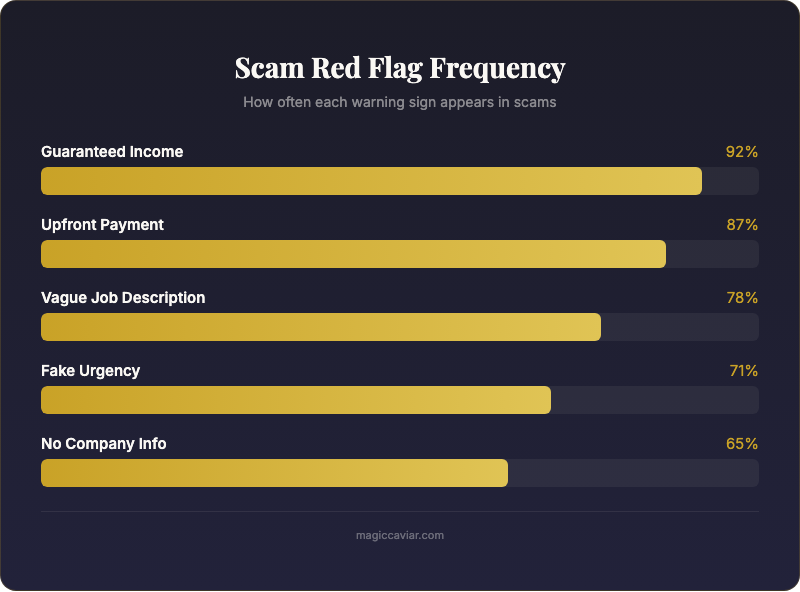
Seven red flags signal a remote job scam: upfront fees for equipment or training, vague job descriptions with no specific duties, pay that far exceeds market rates for the role, communication only through messaging apps (no phone or video), a Gmail or Yahoo email address instead of a company domain, pressure to accept immediately, and requests for personal financial information before a formal hire.
| Red Flag | What It Looks Like | What Is Actually Happening |
|---|---|---|
| Upfront fees | “Pay $99 for training materials to get started” | You pay, receive nothing useful, and the “company” disappears |
| Vague description | “Work from home, earn $5,000/week, no experience needed” | No real job exists; the listing harvests applicant data |
| Above-market pay | “Data entry: $45/hour, no experience required” | Real data entry pays $12-$18/hour; inflated rates bait victims |
| Messaging-only contact | “Interview will be conducted via Telegram” | Scammers avoid traceable communication channels |
| Non-company email | Recruiter contacts from a Gmail or Hotmail address | Legitimate companies use their own domain for hiring |
| Urgency pressure | “Accept this offer by end of day or we move on” | Pressure prevents you from researching the company |
| Financial info early | “Provide your bank details for direct deposit setup” | Identity theft; no employer needs banking info before hiring |
According to the Federal Trade Commission, job scams are among the top reported fraud categories. The FTC’s Consumer Sentinel Network receives thousands of job scam complaints annually. Remote work scams surged in recent years as more people searched for work-from-home opportunities.
Which remote job boards are actually trustworthy?
FlexJobs is the most thoroughly vetted remote job board, manually screening every listing before publication. We Work Remotely charges employers to post, which filters out low-quality listings. LinkedIn Jobs verifies company pages. Remote OK and Remote.co are also reputable. Avoid Craigslist, Facebook groups, and Telegram channels for job searching.
| Job Board | Screening Method | Cost to Job Seeker | Best For |
|---|---|---|---|
| FlexJobs | Hand-screened by staff | $9.95/week or $24.95/month | Verified listings, scam-free browsing |
| We Work Remotely | Paid employer listings ($299+) | Free | Tech, design, marketing roles |
| LinkedIn Jobs | Verified company profiles | Free | All industries, networking |
| Remote OK | Paid employer listings | Free | Tech and startup roles |
| Remote.co | Curated listings | Free | Remote-first companies |
FlexJobs charges a subscription fee, which is unusual for a job board. The fee funds their screening process. Every listing is researched by their team before publication. According to FlexJobs’ scam-free guarantee, they reject thousands of listings monthly that fail their verification process. The subscription is a worthwhile investment during an active job search.
Company career pages are the most reliable source. If you find a role on any job board, navigate to the company’s actual website and confirm the position is listed there. Scammers frequently impersonate real companies on third-party boards.
How do you verify a remote employer is real?
Run five checks before providing any personal information. Search the company name on the Better Business Bureau website. Look for the company on Glassdoor for employee reviews. Check their LinkedIn company page for employee count and activity. Verify their website domain age using a WHOIS lookup. Search “[company name] scam” and “[company name] review” on Reddit and Google.
A legitimate company leaves a trail. It has a website with a custom domain (not a free Wix or WordPress.com site). It has employees on LinkedIn. It has reviews on Glassdoor. It has a physical address and phone number. It appears in state business registries.
Scam companies leave no trail or a freshly fabricated one. Their website was registered last month. Their LinkedIn has no employees. Their Glassdoor has no reviews. Their address is a virtual office or does not exist. These are the signals that save you from wasting time or losing money.
The domain age check is particularly revealing. Run the company’s website URL through a WHOIS lookup. A company claiming 10 years of experience with a website registered 3 weeks ago is not who they claim to be.
What should you do if you encounter a remote job scam?
Report to three places: the FTC at ReportFraud.ftc.gov, the FBI’s Internet Crime Complaint Center (IC3), and the job board where you found the listing. If you shared financial information, contact your bank immediately to freeze accounts and dispute unauthorized transactions. If you shared your Social Security number, place a fraud alert with the three credit bureaus.
Many victims feel embarrassed and do not report. The FTC uses aggregate complaint data to identify scam networks and take enforcement action. Your report matters even if you did not lose money. Attempted scams are reportable and help build cases against repeat offenders.
If you paid money to a scammer via credit card, file a chargeback through your card issuer. Credit card chargebacks have a high success rate for fraud cases. Wire transfers and cryptocurrency payments are rarely recoverable, which is exactly why scammers prefer them.
My honest take: the remote job market is overwhelmingly legitimate. The scams are loud and visible, but they represent a small fraction of actual opportunities. Using verified job boards, verifying employers, and recognizing red flags reduces your risk to near zero. Do not let fear of scams prevent you from pursuing genuine remote work opportunities.
For more on specific remote roles, see our guide on the best remote jobs for introverts and remote opportunities for college students.
Sources
- Federal Trade Commission
- FTC Report Fraud
- FBI Internet Crime Complaint Center
- Better Business Bureau
- FlexJobs Scam-Free Guarantee
- We Work Remotely
Links verified at the time of writing.
Frequently Asked Questions
Is FlexJobs worth the subscription fee?
Yes, if you are actively job searching. FlexJobs manually screens every listing, eliminating scams entirely. The $24.95 monthly fee pays for itself by saving you from wasting time on fake listings. Cancel after you find a job. The service is most valuable during the first 1 to 3 months of an active search.
Can a legitimate employer ask for your Social Security number?
Only after a formal job offer and during official onboarding for tax forms (W-4 or I-9). Never provide your SSN during the application or interview process. No legitimate employer needs it before hiring you. If asked early, it is either a scam or a company with poor security practices.
Are work-from-home jobs on Indeed and ZipRecruiter safe?
Indeed and ZipRecruiter are legitimate platforms, but they do not manually screen every listing the way FlexJobs does. Scam listings occasionally appear. Apply the same verification steps: check the company on BBB and Glassdoor, verify the domain age, and never pay upfront fees.
What if a company wants to interview only through chat?
This is a major red flag. Legitimate companies conduct interviews through phone or video calls. Chat-only interviews allow scammers to impersonate real companies without revealing their identity. Insist on a video call. If they refuse, walk away.
Related Guides