Online courses can generate genuine passive income, but only after significant upfront work. The creation process takes 40 to 100 hours for a quality course. The platform choice determines whether you keep 97% of each sale or 37%. Udemy provides a built-in audience but takes a large commission. Teachable gives you full pricing control but no traffic. This guide covers the complete process from topic selection to first sale.
Choose a topic where you are in the top 10% of knowledge among your target audience, not the top 1% globally. Validate demand by checking existing courses on Udemy. Create your course using free tools like OBS Studio and Canva. Host on Teachable if you have an audience or Udemy if you need one. Most first courses take 40 to 100 hours to create and earn $500 to $2,000 in their first year.
The online education market continues to grow. According to Statista, the global e-learning market is projected to exceed $400 billion. But individual course creators face real challenges: platform fee structures that eat into margins, the difficulty of standing out among millions of courses, and the time investment required to create quality content. This guide addresses each challenge with specific solutions. We verify all platform data as described on our How We Research page. For a broader passive income perspective, see our complete passive income guide.
Which platform should you use to sell courses?
Six platforms serve different needs. Udemy provides the largest marketplace audience but gives you the least control over pricing and commissions. Teachable and Thinkific give you full control but require you to bring your own traffic. Skillshare pays per minute watched. The right choice depends on whether you already have an audience or need one.
| Platform | Monthly Fee | Commission on Sales | Built-in Audience | Pricing Control | Best For |
|---|---|---|---|---|---|
| Udemy | Free | 63% on organic, 3% on instructor promo | Large | Limited | Beginners with no audience |
| Skillshare | Free for teachers | Revenue share per minute | Large | None | Short, skill-based classes |
| Teachable | $39/month (Basic) | 5% on Basic, 0% on Pro | None | Full | Creators with an audience |
| Thinkific | Free (1 course) | 0% | None | Full | Testing with one free course |
| Kajabi | $149/month | 0% | None | Full | Established course businesses |
| Gumroad | Free | 10% flat | Small | Full | Simple digital product sales |
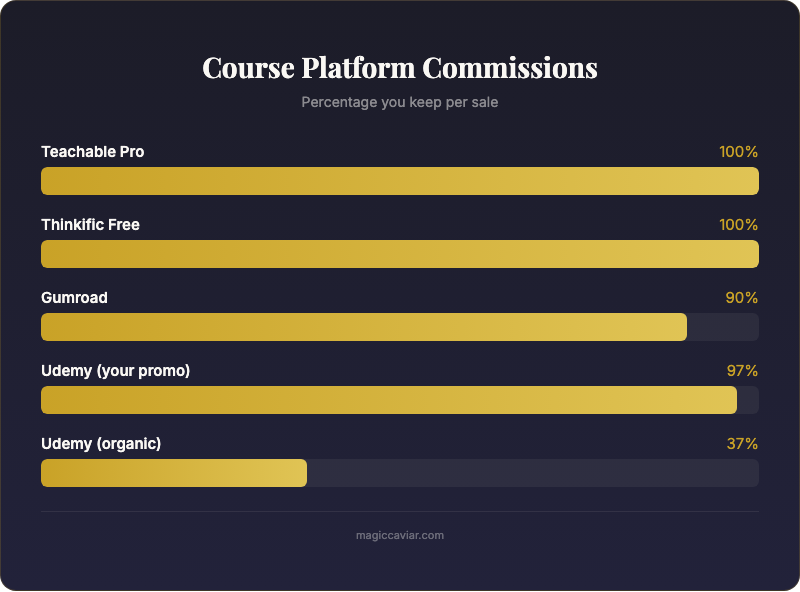
The commission structure matters enormously. On Udemy, if a student finds your course through Udemy’s search, Udemy keeps 63% of the sale price. A $50 course earns you $18.50. If you drive the sale through your own promotion link, you keep 97%. This split means Udemy works best as a discovery platform, not a primary revenue source.
Teachable charges a monthly fee but takes little to no commission. On their Pro plan at $119 per month, you keep 100% of course revenue. This makes sense once your monthly course sales exceed $200 to $300, at which point the subscription pays for itself compared to Udemy’s commission.
Thinkific offers a free plan with one course and zero commission. It is the best option for testing your first course without any financial commitment.
How do you choose a profitable course topic?
Search Udemy for courses in your topic area. If you find courses with 1,000 or more reviews, the demand is proven. If no courses exist, the demand may not be there. Look for topics where existing courses have high enrollment but low ratings, meaning the audience exists but current options disappoint. That is your opportunity.
Your topic should sit at the intersection of three things: something you know well, something people actively search for, and something where existing courses leave gaps.
Validate demand before creating anything. Search Udemy for your topic keyword. Check the top 10 results. If they collectively have over 10,000 enrollments, the demand is real. Read their one-star and two-star reviews to find what students complain about. Those complaints become your course’s selling points.
Topics in professional skills (Excel, data analysis, project management), software tutorials (Figma, Canva, QuickBooks), and practical how-to content (photography, cooking techniques, language learning) consistently sell well. Abstract topics like “finding your purpose” or “mindset mastery” are harder to sell because the outcome is vague.
What equipment do you need to create a course?
A computer, a USB microphone ($30 to $60), and free screen recording software (OBS Studio) cover 90% of course creation needs. Audio quality matters more than video quality. Students tolerate average visuals but abandon courses with poor audio. A $50 microphone is the single best investment you can make.
You do not need a DSLR camera, a studio, or professional lighting for your first course. Most successful Udemy courses are screen recordings with voiceover. The instructor’s face appears in a small corner overlay or not at all.
OBS Studio is free and handles both screen recording and webcam capture. Canva creates professional slide presentations for free. Audacity (free) handles audio editing if you need to remove background noise or edit pauses.
Total startup cost: $30 to $60 for a USB microphone like the Fifine K669 or Blue Snowball. Everything else is free.
How long does it take to create a course?
A quality course takes 40 to 100 hours to create, including planning, recording, editing, and platform setup. Plan on two to four weeks of focused work if you dedicate 15 to 20 hours per week. A minimum viable course is 2 to 4 hours of video content, divided into 5 to 15 minute lessons. Shorter lessons have higher completion rates according to platform data.
The creation process breaks into five phases. Outline your curriculum (5 to 10 hours). Create slides and materials (10 to 20 hours). Record video and audio (10 to 25 hours). Edit and polish (10 to 20 hours). Set up the platform listing with description, pricing, and promotional materials (5 to 15 hours).
My honest advice: do not aim for perfection on your first course. A “good enough” course that launches earns infinitely more than a perfect course that never ships. You can update and improve the content after launch based on student feedback.
For other passive income methods that complement course creation, explore our guide on the best digital products for passive income and our overview of selling printables on Etsy.
How much money can a first course realistically earn?
A first course on Udemy typically earns $500 to $2,000 in its first year. Top-performing courses in high-demand topics earn $5,000 to $20,000 annually. On self-hosted platforms like Teachable, earnings depend entirely on your marketing ability. Creators with email lists of 1,000 or more subscribers often earn $3,000 to $10,000 per course launch.
Udemy prices most courses between $10 and $30 during their frequent sales (the platform runs promotions regularly). Even if your course is listed at $100, most students buy during a sale at $12 to $15. Plan your revenue projections around the discounted price, not the list price.
On Teachable at full price control, $50 to $200 is the typical range for courses targeting professionals. A course priced at $100 with a 2% conversion rate needs 500 landing page visitors per month to generate $1,000. Building that traffic requires marketing effort through email, social media, or paid ads.
The compounding factor is multiple courses. One course earns modestly. Three to five courses in related topics create a catalog that cross-sells. Students who complete one course often buy others from the same instructor.
Sources
- Udemy Official Site
- Teachable Official Site
- Thinkific Official Site
- OBS Studio
- Statista: E-learning Market Data
- Canva Official Site
Links verified at the time of writing.
Frequently Asked Questions
Do you need to be an expert to create an online course?
You need to know more than your target student, not more than everyone in the field. A data analyst who has used Excel for five years can teach Excel to beginners. A professional photographer can teach a beginner camera course. Teach what you know to people who know less.
How long should an online course be?
Two to four hours of video content for a beginner course. Each lesson should be 5 to 15 minutes. Shorter lessons have higher completion rates. A 10-hour course sounds impressive but most students never finish it, leading to negative reviews.
Can you sell the same course on multiple platforms?
Udemy requires its courses to be offered at the lowest price available anywhere. If you sell on Udemy and Teachable, your Teachable price must match or exceed the Udemy sale price. Skillshare is non-exclusive. Read each platform’s terms before cross-listing.
Is it better to sell a course or create a membership?
Start with a standalone course. Memberships require ongoing content creation, which is a significant time commitment. Once you have three or more courses and a loyal audience, bundling them into a membership at $20 to $50 per month can increase total revenue.
Related Guides