Faceless YouTube channels earn real money without showing your face or recording yourself on camera. Channels in finance, technology, and self-improvement niches generate $10 to $30 RPM (revenue per thousand views) using stock footage, screen recordings, and AI or human voiceover. You can start a faceless channel with free tools, though investing $20 to $50 per month in better assets accelerates growth significantly.
A faceless YouTube channel uses stock footage, motion graphics, screen recordings, or animation instead of a human presenter. The five highest-RPM faceless niches are personal finance, technology reviews, business education, health explainers, and true crime. Most faceless channels reach monetization (1,000 subscribers and 4,000 watch hours) within 6 to 12 months of consistent weekly uploads.
This guide covers niche selection, content creation workflow, monetization timelines, and realistic earnings at each growth stage. Every tool and platform mentioned was verified at the time of writing. For the broader platform landscape, see our guide to platforms for making money online. For a related angle, read our Upwork vs Fiverr comparison or see our earlier guide on making money on YouTube without showing your face. Our research process is detailed on the How We Research page.
What are the best niches for faceless YouTube channels?
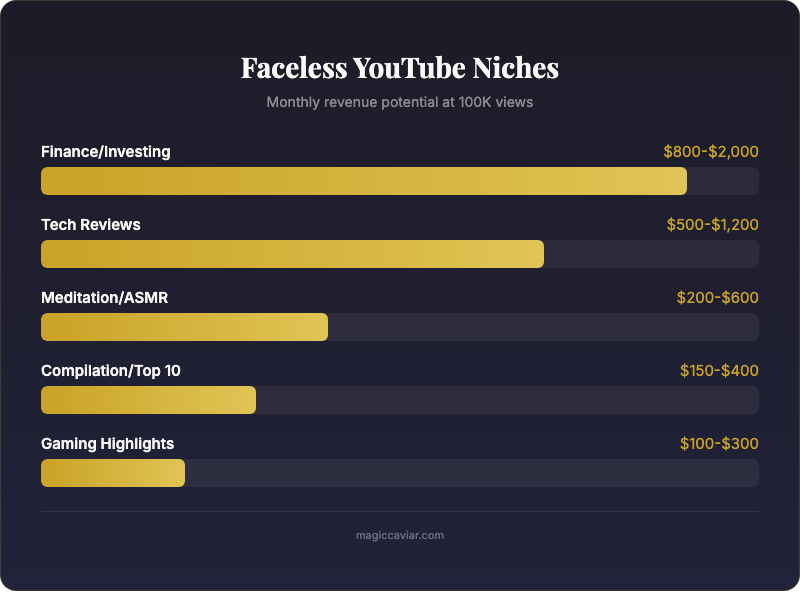
The best faceless niches combine high advertiser demand (which drives RPM) with topics that work without a human presenter. Personal finance, technology, and business education top the list because advertisers in these verticals pay premium CPMs. True crime and history channels also perform well because the content is narrative-driven and pairs naturally with archival footage and graphics.
| Niche | Estimated RPM | Content Format | Competition Level | Evergreen Potential |
|---|---|---|---|---|
| Personal Finance | $15 – $30 | Voiceover + motion graphics | High | Very High |
| Technology/Software | $12 – $25 | Screen recordings + voiceover | High | Medium (updates needed) |
| Business Education | $10 – $22 | Voiceover + stock footage | Medium | High |
| Health/Wellness | $8 – $18 | Animation + voiceover | Medium | High |
| True Crime/Mystery | $6 – $15 | Narration + archival footage | High | Very High |
| History/Geography | $5 – $12 | Maps + narration + archives | Low | Very High |
| Motivation/Self-Help | $4 – $10 | Voiceover + stock footage | Very High | Medium |
RPM varies by season, audience location, and specific topic. Finance content in January (New Year financial planning) earns significantly more than the same content in July. US-based audiences generate 3 to 5 times more ad revenue than audiences in developing countries.
According to YouTube’s revenue sharing documentation, creators keep 55% of ad revenue. A video with 100,000 views at $15 RPM generates approximately $1,500 in gross ad revenue and $825 for the creator after YouTube’s cut.
What tools do you need to create faceless videos?
A faceless video requires three elements: visuals (stock footage, screen recordings, or motion graphics), audio (voiceover, music, and sound effects), and editing software to combine them. Free options include DaVinci Resolve for editing, Pexels for stock footage, and your own voice for narration. Paid options like Storyblocks ($15/month for unlimited stock) and ElevenLabs ($5/month for AI voice) produce more polished results.
Visuals: Pexels and Pixabay offer free stock footage with no attribution required. For higher quality, Storyblocks provides unlimited downloads at $15 to $30 per month. Screen recordings using free tools like OBS Studio work well for tech and tutorial content.
Audio: Your own voice is free and builds channel identity. If you prefer not to narrate, AI voiceover tools like ElevenLabs produce natural-sounding speech starting at $5 per month. Background music from YouTube’s Audio Library is free and pre-cleared for monetized videos.
Editing: DaVinci Resolve is a professional-grade video editor available for free. CapCut is simpler and also free, with built-in effects and transitions. Both handle everything a faceless channel needs.
How long does it take to reach monetization?
YouTube’s Partner Program requires 1,000 subscribers and either 4,000 watch hours in 12 months or 10 million Shorts views in 90 days. Most faceless channels uploading one to two long-form videos per week reach these thresholds in 6 to 12 months. Channels in high-demand niches with strong SEO can reach monetization faster. Channels with inconsistent upload schedules often take 18 months or longer.
The 4,000 watch hours requirement means your content must hold attention. A 10-minute video watched to completion by 400 viewers contributes 66.7 watch hours. You need roughly 60 such videos viewed fully to hit the threshold. In practice, not every viewer watches to the end, so you need more content and more views.
Upload consistency matters more than production value in the first 6 months. YouTube’s algorithm rewards channels that publish regularly. One video per week is the minimum viable cadence. Two per week accelerates growth noticeably.
How much can a faceless channel realistically earn?
A faceless channel with 10,000 subscribers typically earns $200 to $800 per month from ad revenue alone. At 50,000 subscribers, expect $1,000 to $4,000 monthly. At 100,000 subscribers, $3,000 to $10,000 monthly is realistic in high-RPM niches. These figures cover ad revenue only. Affiliate links, sponsorships, and digital product sales can double or triple total income.
| Subscriber Count | Monthly Views (Typical) | Ad Revenue Range | Total Income Potential |
|---|---|---|---|
| 1,000 (monetized) | 10,000 – 30,000 | $50 – $300 | $50 – $400 |
| 10,000 | 50,000 – 150,000 | $200 – $800 | $300 – $1,500 |
| 50,000 | 200,000 – 500,000 | $1,000 – $4,000 | $2,000 – $8,000 |
| 100,000 | 500,000 – 1,500,000 | $3,000 – $10,000 | $5,000 – $20,000 |
My honest opinion: faceless channels are one of the best long-term passive income strategies. The first 12 months require consistent effort with minimal financial return. After monetization, older videos continue generating views and revenue with no additional work. A library of 100 evergreen videos can produce income for years.
The key risk is burnout before monetization. Producing weekly videos for 6 to 12 months without earning anything tests your commitment. Start with a niche you genuinely find interesting. The creators who succeed are the ones who would make the content even without the revenue.
Sources
Links verified at the time of writing.
Frequently Asked Questions
Can YouTube detect AI voiceover and demonetize your channel?
YouTube does not penalize channels for using AI voiceover. The platform’s policies focus on content quality, originality, and advertiser guidelines. Channels using AI voices are eligible for monetization as long as the content provides value beyond what could be found through a simple search. Purely AI-generated compilations with no added insight may be flagged as repetitive content.
Do faceless channels grow slower than face-on-camera channels?
Not necessarily. Some of the fastest-growing YouTube channels are faceless. The growth rate depends on content quality, niche demand, and SEO optimization. Face-on-camera channels build personal brand faster, which helps with sponsorships and community. Faceless channels compete on content value and discoverability.
Is it legal to use stock footage on monetized YouTube videos?
Yes, as long as you use footage with a license that permits commercial use. Pexels, Pixabay, and Storyblocks all provide licenses that cover monetized YouTube content. Always verify the license terms for each clip. Never use footage from Google Image Search or other unverified sources.
How many videos should you publish before expecting results?
Publish at least 30 videos before evaluating performance. YouTube’s algorithm needs data to understand your content and audience. Most creators see meaningful growth between video 30 and 50. Judging your channel’s potential after 5 or 10 videos is premature.
Related Guides