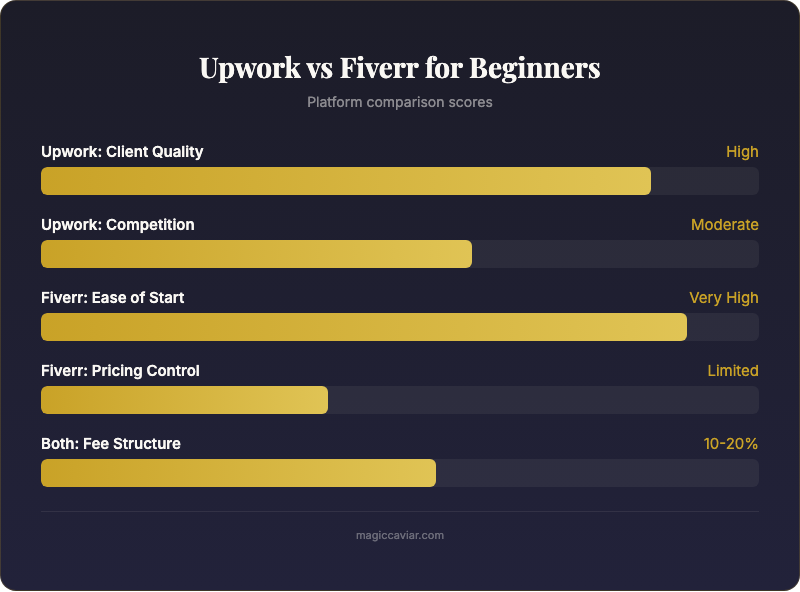
Upwork and Fiverr are the two largest freelance marketplaces, but they operate on fundamentally different models. Upwork is a job board where you pitch clients. Fiverr is a storefront where clients find you. Upwork charges 10% on earnings per client. Fiverr takes 20% on every order. The right choice depends on your skill type, how you prefer to find work, and whether you want to set your own rates or let the market decide.
Upwork is better for freelancers who want long-term client relationships and higher per-project rates. Fiverr is better for freelancers who want a steady stream of small orders without writing proposals. Upwork favors writers, developers, and consultants. Fiverr favors designers, video editors, and service providers with productized offerings.
This comparison uses current fee structures, platform policies, and earnings data verified through official sources. For the broader platform landscape, see our guide to online platforms for making money. Our research process is on the How We Research page.
How do Upwork and Fiverr fees compare?
Upwork charges freelancers a flat 10% service fee on all earnings per client. Fiverr charges freelancers 20% on every completed order regardless of size. On a $500 project, Upwork keeps $50 and you earn $450. Fiverr keeps $100 and you earn $400. Upwork also charges clients a marketplace fee, while Fiverr charges buyers a service fee on top of the listed price.
| Feature | Upwork | Fiverr |
|---|---|---|
| Freelancer Fee | 10% flat | 20% flat |
| Client Fee | 3% to 5% marketplace fee | 5.5% service fee (min $2.50) |
| Minimum Project Price | No minimum (hourly or fixed) | $5 per gig |
| Payment Schedule | 5-day security period after approval | 14-day clearance period |
| Withdrawal Options | Direct deposit, PayPal, wire | PayPal, bank transfer, Fiverr Revenue Card |
| Free Proposals/Month | 10 Connects free (extras $0.15 each) | Unlimited (no proposal system) |
| Profile Visibility | Requires active bidding | Gig appears in search automatically |
| Long-Term Contracts | Supported (weekly billing) | Limited (repeat orders only) |
According to Upwork’s fee page, the 10% rate applies universally. Upwork simplified its fee structure when it removed the tiered system (which previously charged 20% on the first $500 per client). This change made Upwork more competitive with Fiverr on small projects.
Fiverr’s 20% fee is the highest among major freelance platforms. On low-priced gigs ($5 to $25), the fee is painful. On a $10 order, you keep only $8. According to Fiverr’s terms, the 20% applies to the total order amount including extras and tips.
Which platform is better for getting your first client?
Fiverr is faster for a first sale because buyers come to you. You create a gig listing, optimize it for Fiverr’s search algorithm, and wait for orders. On Upwork, you must actively search for jobs and submit proposals, competing against established freelancers with reviews and work history. Most beginners get their first Fiverr sale within 2 to 4 weeks. First Upwork projects typically take 3 to 6 weeks of consistent bidding.
Fiverr’s advantage for beginners is its marketplace model. Your gig listing works like a product page. Buyers search for a service, browse options, and place an order. You do not need to write proposals or convince anyone to hire you. The listing does the selling.
Upwork requires more effort upfront. Each proposal costs Connects (Upwork’s bidding currency). You get 10 free Connects per month. Most job posts cost 2 to 6 Connects to apply. A competitive proposal needs to be personalized, reference the client’s specific needs, and include relevant samples.
The tradeoff: Fiverr’s ease of entry means more competition at lower price points. Upwork’s higher barrier filters out casual sellers, which means less competition for serious freelancers willing to put in proposal effort.
Which skills earn the most on each platform?
Upwork favors skills that require ongoing work: web development, content writing, virtual assistance, and consulting. These lend themselves to long-term contracts billed weekly or monthly. Fiverr favors skills with clear deliverables: logo design, video editing, voiceover, and social media graphics. These work as productized services where the scope is defined upfront.
| Skill | Better Platform | Typical Rate (Beginner) | Why |
|---|---|---|---|
| Web Development | Upwork | $30 – $75/hour | Projects are complex, ongoing |
| Content Writing | Upwork | $0.05 – $0.15/word | Retainer-based client relationships |
| Logo Design | Fiverr | $25 – $100/order | Clear deliverable, high search volume |
| Video Editing | Fiverr | $25 – $150/order | Productized service format |
| Virtual Assistant | Upwork | $12 – $25/hour | Ongoing hours, weekly billing |
| Voiceover | Fiverr | $20 – $100/order | Per-project pricing model |
| Social Media Management | Upwork | $15 – $35/hour | Monthly retainer model |
| Graphic Design | Fiverr | $15 – $75/order | Quick turnaround projects |
The pattern is clear. If your work is best sold as a defined package (“I will design your logo for $50”), Fiverr works better. If your work is best sold as ongoing hours or custom projects (“I will manage your website for $40/hour”), Upwork works better.
Can you use both platforms at the same time?
Yes. There is no exclusivity requirement on either platform. Many successful freelancers maintain profiles on both. A practical strategy: use Fiverr for quick, productized services that generate steady small orders, and use Upwork for larger projects and long-term client relationships. This diversifies your income across two channels.
The risk of splitting attention is spreading yourself too thin. If you are just starting out, pick one platform, build your reputation there for 3 to 6 months, and then expand. A strong Fiverr profile with 50 reviews is worth more than two weak profiles with 5 reviews each.
My honest take: start on Fiverr if you want quick wins and validation. Start on Upwork if you want to build a sustainable freelance business with recurring revenue. Both paths work. The wrong choice is trying both half-heartedly. For more on building your freelance career, read our guide on starting a faceless YouTube channel for a completely different platform approach, or explore whether dropshipping is worth it for product-based alternatives.
Sources
- Upwork Fee Structure
- Fiverr Terms of Service
- Upwork Official Site
- Fiverr Official Site
- Bureau of Labor Statistics Occupational Outlook
Links verified at the time of writing.
Frequently Asked Questions
Is Upwork free to join?
Yes. Creating an Upwork profile is free. You receive 10 Connects per month for submitting proposals. Additional Connects cost $0.15 each. There are no monthly subscription fees for the basic freelancer account. Upwork Plus costs $14.99 per month and provides extra Connects and profile visibility.
Can you make a full-time income on Fiverr?
Yes, but it requires volume or premium pricing. Fiverr sellers earning $3,000 or more per month typically have 100 or more reviews, multiple gig offerings, and prices above $50 per order. It takes most sellers 6 to 12 months of consistent work to reach full-time income levels.
Why does Fiverr charge 20% while Upwork charges 10%?
Fiverr provides the marketplace traffic and buyer discovery. You do not need to write proposals or actively seek clients. That marketing value is built into the higher fee. Upwork requires you to find and pitch clients yourself, so the fee is lower. Each model has tradeoffs.
Which platform has better client quality?
Upwork generally attracts higher-budget clients because its model caters to businesses hiring for ongoing work. Fiverr attracts a wider range, from individuals seeking $5 services to agencies placing large orders. Both platforms have excellent and problematic clients. Reviews and communication before accepting work help you filter.
Related Guides