Freelancing
How to Get Your First Freelance Client with No Portfolio
Last reviewed: September 1, 2026
You do not need a portfolio to land your first freelance client. You need a clear offer, one relevant sample, and the willingness to reach out to real people. Spec work, free samples for local businesses, and a well-optimized Upwork profile can each produce a paying client within two to four weeks. This guide covers the exact system, including a cold outreach template that works.
The fastest path to your first client: create two to three spec samples in your skill area, set up a complete Upwork profile, submit 10 to 15 personalized proposals per week, and simultaneously pitch three to five local businesses directly. Most beginners land their first paying client within two to four weeks using this parallel approach.
The portfolio paradox stops most people before they start. You need clients to build a portfolio, but you need a portfolio to get clients. The solution is to skip the traditional portfolio entirely and use alternative proof of competence instead. For a wider view of freelancing, see our complete freelancing guide. We verify platform claims using the process described on our How We Research page.
Create spec work for real businesses without charging them. Pick three to five businesses in your target niche, do the work (write their blog post, redesign their social media, organize their spreadsheet), and present the result as a sample. This demonstrates your skill on a real problem, which is more convincing than a hypothetical case study.
Spec work means creating real deliverables for real businesses without being hired. A freelance writer might write a 1,000-word blog post for a local restaurant’s website. A virtual assistant might create a sample content calendar for a small business. A graphic designer might redesign a local shop’s Instagram grid.
The key is specificity. “I can write blog posts” is a claim. “I wrote this blog post for a dental practice about teeth whitening options” is proof. Three specific samples outperform a generic portfolio of twenty hypothetical pieces.
Another approach: offer free work to nonprofits or small businesses in exchange for a testimonial. Three to five testimonials from real business owners carry more weight than any portfolio. Post these on your LinkedIn profile and Upwork summary.
Your Upwork profile needs five elements to convert: a professional headshot, a headline that names your service and target client, a summary that addresses the client’s problem first, your spec samples in the portfolio section, and a competitive starting rate. According to Upwork’s own guidance, profiles with photos receive significantly more invitations than those without.
| Profile Element | What Works | What Fails | Impact on Hiring |
|---|---|---|---|
| Headline | “Blog Writer for SaaS Companies” | “Writer | Blogger | Content Creator” | High |
| Summary (first line) | “Your website needs content that converts visitors into customers.” | “I am a passionate writer with 3 years of experience.” | Very High |
| Photo | Clear headshot, neutral background | No photo, blurry selfie, group photo | High |
| Portfolio | 2-3 spec samples relevant to your niche | Empty or college assignments | Medium |
| Rate | $15 to $25/hr (starter), raise after 5 jobs | $5/hr (signals low quality) | Medium |
Set your starting rate at $15 to $25 per hour depending on your skill area. Pricing below $10 per hour attracts the worst clients and signals that you do not value your own work. After completing five projects with positive reviews, raise your rate by 20% to 30%. For detailed pricing guidance, see our guide on setting freelance rates as a beginner.
A winning proposal opens with the client’s problem, not your credentials. Reference something specific from the job posting. Explain your approach in two to three sentences. Link one relevant sample. State your price and timeline clearly. Keep the total under 150 words. Clients receive 20 to 50 proposals per job and skim most of them.
Here is a template that converts:
“Hi [Name], I noticed your job posting mentions [specific detail]. I would approach this by [your specific plan in two sentences]. Here is a sample of similar work I completed: [link]. I can deliver this within [timeframe] for [price]. Happy to discuss the details if you have questions.”
That is the entire proposal. No life story, no list of skills, no paragraph about your passion for writing. Every sentence addresses the client’s needs, not yours.
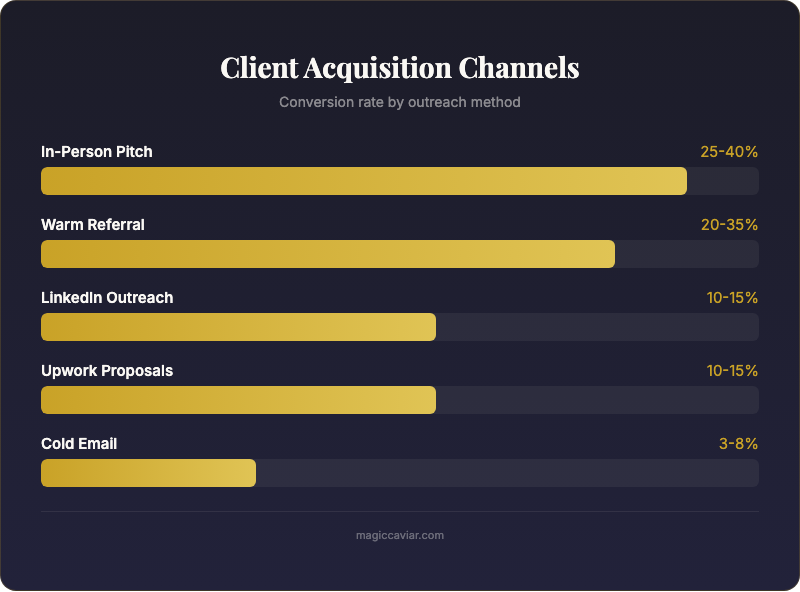
Submit 10 to 15 personalized proposals per week. At a typical 10% to 15% response rate, that produces one to two conversations per week. Most conversations convert to paying work if you follow up within 24 hours.
Yes. Local businesses are the most underrated source of freelance work. Walk into restaurants, salons, and retail shops with a tablet showing your spec work. Small business owners prefer working with someone they can meet. The conversion rate on in-person pitches is far higher than cold emails because you eliminate the trust barrier instantly.
LinkedIn is another direct channel. Search for small business owners and marketing managers. Send a personalized connection request followed by a brief message referencing their current online presence with a specific improvement suggestion. Do not attach your portfolio. Show one relevant example and ask for a quick conversation.
Cold email works too, but only if you reference something specific. “I noticed your website’s blog has not been updated in three months. I wrote a sample post for you: [link]. If you like it, I can write one post per week for $X.” That email takes five minutes and demonstrates initiative.
The combination of Upwork proposals and direct outreach is more effective than either alone. Upwork brings inbound leads once your profile ranks. Direct outreach produces immediate results. Run both simultaneously for the fastest path to your first client. For related freelancing strategies, see our guide on making a full-time income as a freelance writer.
Over-deliver on your first project. Complete it ahead of schedule. Add one small extra that the client did not ask for. Then ask for a testimonial and a referral. One satisfied client who refers you to two colleagues creates a pipeline that replaces cold outreach entirely. The referral chain is how experienced freelancers build full practices.
Your first client sets the trajectory. A five-star review on Upwork makes your second client easier to land. A testimonial from a local business owner makes the next pitch more credible. Every first client is an investment in all future clients.
Do not undercharge out of gratitude for being hired. Deliver exceptional work at a fair rate. Clients who pay $15 per hour expect $15 per hour quality. Giving $50 per hour quality at $15 per hour does not build loyalty. It builds an expectation of below-market pricing that is hard to break.
Links verified at the time of writing.
Expect a 10% to 15% response rate on well-written, personalized proposals. That means 7 to 10 proposals before your first response. Send at least 15 per week to maintain momentum. Generic copy-paste proposals have a near-zero response rate.
Only strategically. Create spec work for your own learning. Offer one free deliverable to a business in exchange for a testimonial. Never do extended unpaid work. Clients who expect ongoing free work will never convert to paying clients.
Rejection is normal. Review your proposals for personalization and specificity. Ask a friend to review your Upwork profile. Consider whether you are targeting the right type of client. Most freelancers land their first client between their 15th and 30th proposal.
Fiverr is better for creative services like graphic design and video editing because buyers come to you. Upwork is better for writing, VA, and technical work because you can pitch specific clients. Use both simultaneously for the widest reach.