Freelancing
How to Set Freelance Rates When You Are Just Starting Out
Last reviewed: September 1, 2026
Setting your freelance rate too low attracts demanding clients and signals inexperience. Setting it too high scares away the clients who would actually hire a beginner. The sweet spot is 10% to 20% below the median market rate for your skill level, raised by 20% after every five completed projects. This guide gives you median rates for eight freelance skills and a framework to adjust pricing as you grow.
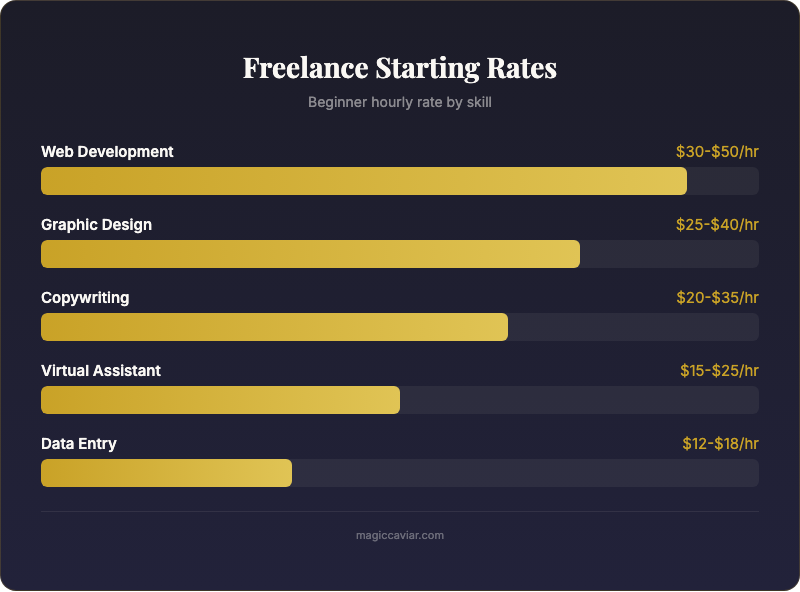
Start 10% to 20% below the median market rate for your skill, not at rock bottom. Freelance writers should start at $0.08 to $0.15 per word. Virtual assistants at $15 to $25 per hour. Graphic designers at $25 to $40 per hour. Raise your rate by 20% after every five completed projects with positive reviews. Never price below $10 per hour for any skill.
Most pricing advice says “charge what you’re worth.” That is useless without data. This guide provides concrete median rates from Upwork marketplace data, Glassdoor, and the Bureau of Labor Statistics. We verified every figure through the process described on our How We Research page. For a broader freelancing overview, see our complete freelancing guide.
Rates vary dramatically by skill. Web developers command the highest hourly rates at $50 to $100 per hour for experienced freelancers. Writers range from $0.05 to $0.50 per word depending on niche and expertise. Virtual assistants sit at $15 to $35 per hour. The table below shows beginner and experienced rates for eight common freelance skills.
| Skill | Beginner Rate | Experienced Rate | Pricing Model | Rate Source |
|---|---|---|---|---|
| Freelance Writing | $0.08 to $0.15/word | $0.25 to $0.75/word | Per word or per article | Upwork, Contently |
| Copywriting | $50 to $100/page | $200 to $500/page | Per page or per project | Glassdoor, AWAI |
| Virtual Assistant | $15 to $25/hour | $25 to $45/hour | Hourly | Belay, Time Etc |
| Graphic Design | $25 to $40/hour | $50 to $100/hour | Hourly or per project | 99designs, Glassdoor |
| Web Development | $30 to $50/hour | $75 to $150/hour | Hourly or per project | Upwork, Toptal |
| Social Media Management | $300 to $800/month | $1,000 to $3,000/month | Monthly retainer | LinkedIn, Upwork |
| Video Editing | $25 to $50/hour | $50 to $100/hour | Per video or hourly | Fiverr Pro, Upwork |
| Bookkeeping | $20 to $30/hour | $35 to $60/hour | Hourly or monthly retainer | Glassdoor, BLS |
These rates reflect US-based freelancers working with US-based clients. International markets have different rate floors. If you serve clients in a specific country, research that market’s rates separately.
Project-based pricing earns more money once you get faster at your work. Hourly pricing penalizes efficiency because the better you get, the less you earn per project. Start with hourly pricing to learn how long tasks take, then switch to project pricing once you can estimate your time accurately. Most experienced freelancers use project pricing.
Hourly pricing works for beginners because you do not yet know how long tasks take. Charging $20 per hour for a project that takes 10 hours gives you $200. If you quoted a flat $150 because you underestimated the time, you lose $50.
Once you complete 10 to 15 similar projects and know your speed, switch to project pricing. A blog post that takes you 3 hours at $25 per hour earns $75 on hourly pricing. The same blog post priced at $150 flat earns double while the client pays a predictable amount. Both sides win.
According to the Bureau of Labor Statistics, the median pay for writers is approximately $73,150 per year. As a freelancer, you need to earn roughly $35 to $40 per billable hour to match that salary after accounting for taxes, insurance, and unbillable time.
Raise your rate by 15% to 25% after every five completed projects with positive reviews. Also raise rates when you are booking out two or more weeks in advance, when more than 50% of prospects accept your price without negotiation, or when you add a new skill or specialization. Never announce a rate increase. Simply quote the new rate to new clients.
Existing clients can stay at their current rate for one to two months as a courtesy, then receive a polite notice that rates will increase on a specific date. Most clients accept a 10% to 15% increase without pushback if you have delivered consistent quality.
The biggest mistake beginners make is never raising rates. A freelancer who starts at $15 per hour and still charges $15 per hour after two years of full-time work is dramatically undervaluing their experience. Each completed project makes you faster and better, which means your effective rate should increase even if your quoted rate stays the same.
For help landing clients who can afford fair rates, see our guide on getting your first freelance client with no portfolio. For role-specific insights, read about becoming a virtual assistant.
Never lower your hourly rate. Instead, reduce the scope of work to fit their budget. If a client wants a $500 project for $300, offer a $300 version with fewer deliverables. This protects your rate integrity while accommodating budget constraints. Clients who insist on rock-bottom pricing are usually the most demanding and least pleasant to work with.
A polite response to rate pushback: “I understand budget is a concern. At that price point, I can deliver [reduced scope]. If you would like the full project as described, my rate is [your rate]. Which would you prefer?”
This puts the choice in the client’s hands without devaluing your work. Some clients genuinely have budget limits and will happily accept a reduced scope. Others are testing whether you will fold. Standing firm signals confidence and professionalism.
My honest opinion: the clients who negotiate hardest on price are almost always the hardest to work with. A client who respects your rate will also respect your time, your process, and your expertise. Price filtering is real. Let cheap clients hire someone else.
Links verified at the time of writing.
Start at the low end of the market range, not at rock bottom. $15 per hour for a beginner VA is reasonable. $5 per hour is not. Low rates attract clients who do not value your work and make it psychologically harder to raise prices later.
If more than 80% of prospects reject your rate, it may be above the market for your experience level. If 50% to 70% accept, your rate is in the right zone. If more than 90% accept without discussion, you are undercharging.
On Upwork, yes. The platform requires an hourly rate and clients filter by budget. On your own website or LinkedIn, listing a range is optional but reduces time spent on mismatched inquiries. “Starting at $X per [unit]” gives prospects a baseline without locking you in.
Value-based pricing sets your rate based on the outcome for the client, not the hours you work. A sales page that generates $50,000 in revenue is worth $2,000 to $5,000 to the client, regardless of whether it took you 5 hours or 50. This model works best once you can demonstrate measurable results from your work.